
CIH
Community Integration and Habilitation provides individualized community supports for eligible people with intellectual or developmental disabilities.
For Indiana Medicaid waiver and HCBS case management
Keep the system your team already uses. Review case notes, person-centered individualized support plans (PCISPs), and related PDFs against your own criteria. Supervisors see the source evidence and decide what needs follow-up.
Configurable criteria · Source-linked findings · Human-reviewed decisions
In August 2026, Indiana transitioned its Bureau of Disabilities Services (BDS) waiver case-management arrangement to five statewide contractors. The Indiana FSSA Waiver Reset page lists Aging & In-Home Services of Northeast Indiana, Indiana Professional Management Group, Inspire Case Management, Unity of Indiana, and The Columbus Organization. These are state contractors; inclusion here does not indicate an OCP customer relationship.
2% of monthly case-management fees is withheld under the contracted BDS arrangement. The first withholding quarter runs November 1, 2026 through January 31, 2027. Indiana distributes funds according to its contract performance measures. This is not a deduction from every Indiana Medicaid claim. Read IHCP bulletin BT2026154.
One Care Portal is not affiliated with Indiana FSSA. It can help your team review selected records. It does not determine contract performance or guarantee payment of withheld fees.
| Performance area | State expectation | What to monitor | Where OCP may help | Outside document review |
|---|---|---|---|---|
| PCISP completion | Complete initial, annual, and updated plans on time. | Plan trigger, due date, version, and official completion timestamp. | Flag gaps in readable plan PDFs using configured criteria. | Meeting the deadline or state acceptance. |
| interRAI assessments | Complete applicable ICF/IID level-of-care assessments on time. | Assessment assignment, due date, and completion recorded in the approved system. | Flag unclear or missing references in supporting notes. | Level-of-care decisions or assessment timeliness. |
| Incidents and corrective actions | Report and follow up on time; verify corrective action plans after substantiated allegations. | Incident timestamps, follow-up, official status, and verification evidence. | Surface missing owners or follow-up details in PDFs. | Official filing, deadlines, or confirmation of corrective action. |
| Mortality review | Complete review activities accurately and on time. | Official review record, due dates, and disposition. | Check authorized supporting records for missing fields. | Completing, validating, or certifying the mortality review. |
| Caseload size | Meet contractual caseload requirements. | Dated rosters, assignments, and applicable contract definitions. | OCP Case Management can show assignments if used as part of the workflow. | Verifying an external roster or calculating the state SLA. |
| Case-manager training | Meet applicable training requirements. | Required courses, completion dates, and official training evidence. | Review authorized supporting PDFs against agency criteria. | Confirming training completion or satisfying a contract requirement. |
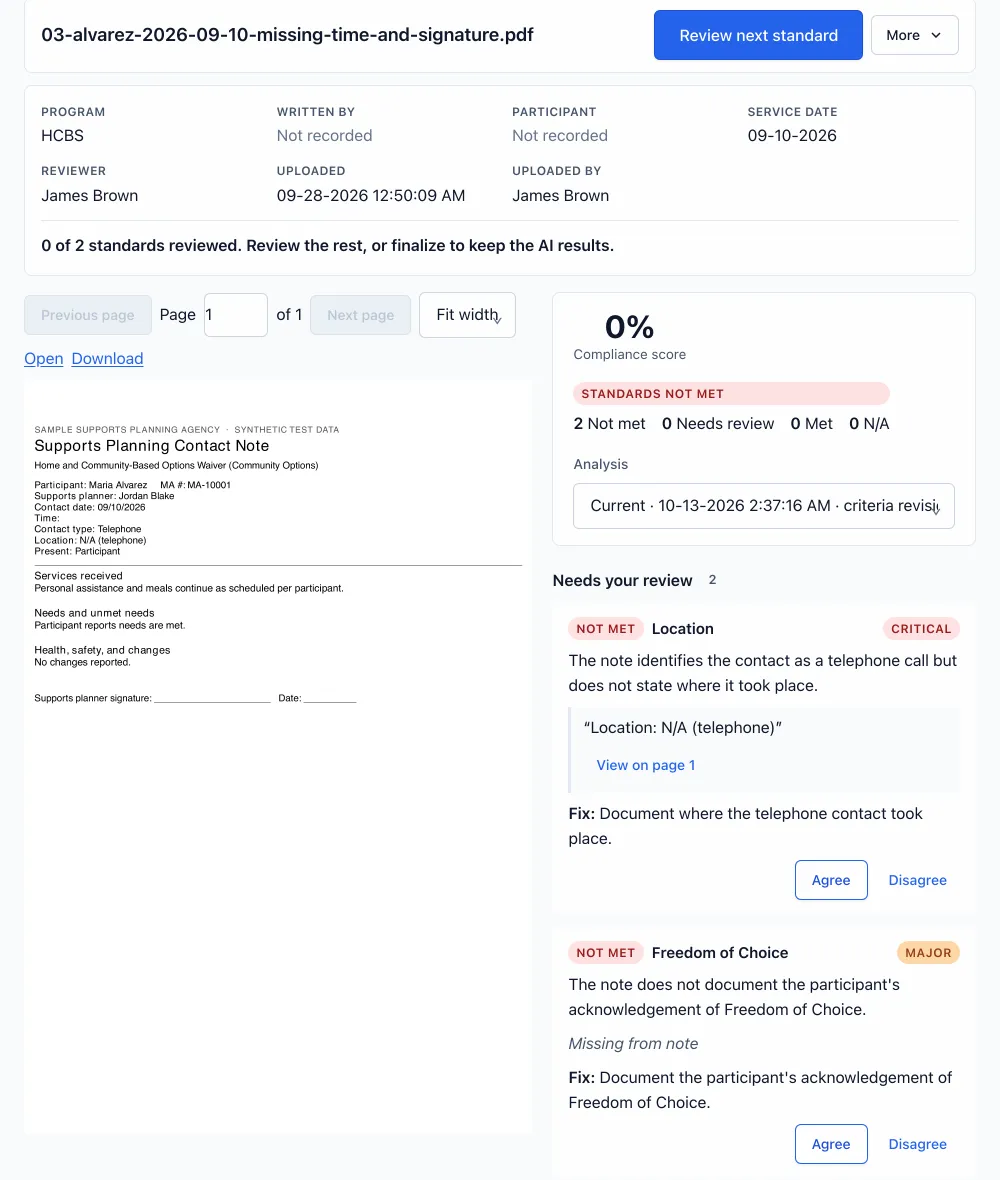
AI findings are advisory. Your team makes the final documentation decision. Optional EHR import depends on compatible API access, customer authorization, and onboarding.
Start with these review prompts, informed by Indiana’s case-management quality guide. They are examples, not a complete checklist for every record or current contract.
| Review area | Supervisor question |
|---|---|
| Goals and outcomes | What does the person want to change, and how will staff recognize progress? |
| Risk and safeguards | Are applicable risks and corresponding supports documented? |
| Informed choice | Where applicable, do records show options considered and the person’s provider selection? |
| Coordination and follow-up | Can the next staff member tell who owns each action and when it is due? |
| Changes and updates | Does the current version reflect relevant changes in circumstances? |
| Signatures or approvals | Where required, is the dated evidence attached to the correct version? |
| Consistency across records | When available, do the current plan, contact notes, and official authorizations tell the same story? |
Confirm eligibility, planning, and evidence requirements for your program with the Indiana BDS waiver overview and your current contract. OCP does not provide state-certified templates.
Community Integration and Habilitation provides individualized community supports for eligible people with intellectual or developmental disabilities.
Family Supports helps eligible children and adults with intellectual or developmental disabilities receive supports in the community.
Health and Wellness offers a community alternative to nursing facility care for eligible people age 59 and younger with disabilities.
TBI provides individualized community services for eligible people with traumatic brain injury.
FSSA includes PathWays fee-for-service in its contracted case-management arrangements. Verify the requirements for that arrangement separately from the four waivers named in BT2026187.
Organize participant records, assigned caseloads, configurable notes, and supervisor review. Use it alongside any required state systems. Explore Case Management.
Submit supported claims, track denials, and reconcile applicable 835 remittances. Confirm payer and enrollment fit first. OCP does not claim to reconcile Indiana’s non-claim-specific withholding distributions automatically. Explore Billing / RCM.
It helps agency staff organize caseloads, plan records, notes and follow-up. It does not replace Indiana reporting or authorization systems.
Beginning November 1, 2026, Indiana withholds 2% of monthly fees under its contracted BDS waiver case-management arrangement. Quarterly distribution depends on contract performance. See IHCP bulletin BT2026154.
No. It applies to the specified contracted BDS case-management arrangement, not to every HCBS provider or individual claim.
PCISP timeliness, interRAI level-of-care assessment timeliness, incidents and corrective actions, mortality review, caseload size, and case-manager training.
It can flag possible gaps in supported PDFs against configured criteria and show source references when available. Qualified staff verify the findings and decide what needs correction.
No. Contract scoring requires the contractor’s definitions, authoritative records and applicable state processes. A PDF review alone cannot establish it.
Yes. Use Compliance Review on its own with readable PDF exports and keep your current system of record. Any automated import depends on compatible API access, authorization and onboarding.
No direct FSSA integration is offered here. Keep using the state and contractual systems required for your work.
No. Indiana determines eligibility for distribution under the contract. Reviewing records does not establish that the agency met the measures.
Effective December 3, 2026, qualifying extensions carry forward services and units authorized in the previous plan’s final month for the first three months. This does not approve new requests. See IHCP bulletin BT2026187.
Yes, using agency-configured criteria for each program. Use the current requirements for that program and validate the criteria before relying on them.
Use the links below. Bring a blank template or your checklist. The public request form collects business details; documents are shared only through the approved secure workflow after a BAA is signed.
Bring a blank template and one criterion that takes supervisors time to check. We’ll show how reviewers see the evidence and record their decisions. Don’t include participant records or protected health information in public forms.