
Billing / RCM for provider agencies, with or without Case Management
Prepare claims, post 835 payments and follow up on denials. Use Billing / RCM with your current system or connect it to OCP Case Management.
A separate billing module for Medicaid, Medicare and commercial payer workflows. No Care Module purchase required.
Supported through clearinghouse workflows. Payer enrollment and supported clearinghouse routes govern claim submission.
- Multi-Payer Claims
- Auto ERA Posting
- Denial Management
- Works Standalone
We'll confirm your program, notes and payer workflow on the demo.
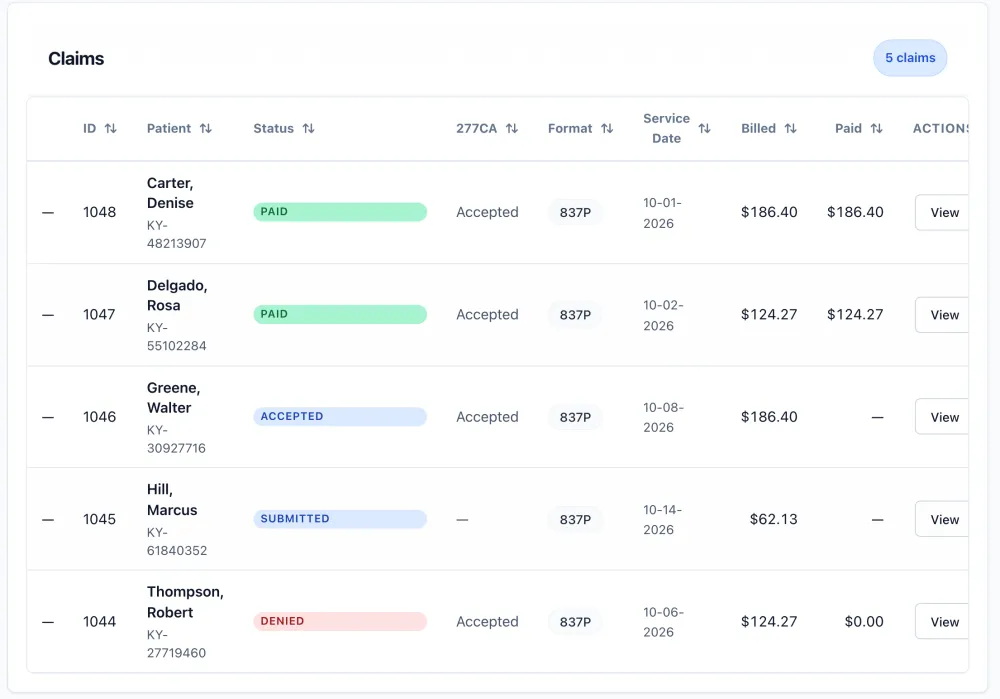

See the claim-to-payment workflow
Review imported services, follow submitted claims, and work remittances and denials in one billing module. Availability of a submission route depends on payer enrollment and clearinghouse support.
A billing workflow without a Care module purchase
One Care Portal’s Care Modules focus on community-based care workflows. Revenue Cycle Management (RCM) is a separate product for agencies with professional or institutional billing data, whether or not you run a waiver program or use our care software. Inside the portal, the module is labelled Billing Hub. Claims use supported clearinghouse routes and require payer enrollment.
Medicaid, Medicaid MCOs, Medicare and Medicare Advantage, and commercial payers through supported clearinghouse workflows. Payer enrollment and supported clearinghouse routes govern claim submission.
$1.50 covers submitting the claim ($1.20) and posting its payment automatically ($0.30); a claim in a parsed manually uploaded 835 file is $0.10 instead of $0.30. Billing and Case Management share one $299 platform fee. Compliance Review has its own subscription.
- No Care Module required
- Import service data from Excel, or connect a Care Module later
- 837P and 837I claims, 835 ERA posting, denial tracking
Connect Billing to OCP Case Management or Adult Day Health Care (ADHC), or use it with your existing care or documentation system.
Complete revenue cycle in one platform
From service delivery to payment posting, manage your entire billing workflow.
Claims generation
Generate claims automatically from verified visits and documented services.
Claim scrubbing
Catch errors before submission. Fix issues that cause denials.
Electronic submission
Submit 837P and 837I claims electronically to Medicaid, MCO, Medicare, and commercial payers through supported clearinghouse workflows. Track status in real time.
ERA auto-posting
835 ERAs post automatically. Match payments to claims without manual entry.
Denial management
Track denials by reason code. Rework and resubmit from one screen.
A/R management
See aging by payer, client, and service across every payer you bill. Know exactly what's outstanding.
Payers you can bill
The same claim scrubbing, submission, ERA posting, and denial workflow supports the major payer categories below.
Medicaid & MCOs
State Medicaid programs and Medicaid managed care plans, including waiver, HCBS, TCM, and adult day services.
Commercial insurance
Commercial and group health plans, submitted as 837P or 837I through supported clearinghouse workflows.
Medicare & Medicare Advantage
Medicare and Medicare Advantage claims, with the same validation, remittance, and denial tracking.
Multi-payer agencies
Billing several payer types at once, including secondary claims. See A/R and denials broken out by payer.
Agencies using this today include case management, adult day and ADHC, waiver and HCBS, IDD, and supportive housing providers — alongside provider agencies with no HCBS programs at all. Payer enrollment and supported clearinghouse routes govern claim submission.
The billing flow
Services delivered
Staff document each service, creating the record a claim is built from.
Claims generated
Claims are created with the required codes, units, and payer details.
Scrubbed & submitted
Errors are caught before submission, and clean claims are sent electronically.
ERA received
835 remittances are parsed and payments are posted to matching claims.
A/R updated
Balances are reconciled, and denials are flagged for follow-up.
Map your billing workflow before you switch
Bring a sample of your billing-data columns (without PHI), payer and plan names, claim type, current submission route, and whether you receive 835 remittances. We will map the supported workflow with your team before setup.
Frequently asked questions
How much does One Care Portal Billing cost?
Billing costs $1.20 per submitted claim. Successful automatic 835 reconciliation adds $0.30 per claim; a claim in a manually uploaded 835 file that is parsed costs $0.10 instead. A submitted claim also reconciled automatically totals $1.50 across those two steps, plus the $299 monthly platform fee that covers Case Management and Billing/RCM. Billing customers do not pay the standalone ERA Dashboard's $99 monthly base for manual uploads.
Which payers can we bill?
The Revenue Cycle Management (RCM) module supports all major payer types: Medicaid and Medicaid MCOs, Medicare and Medicare Advantage, and commercial payers through supported clearinghouse workflows. Payer enrollment and supported clearinghouse routes govern claim submission.
Can we use Revenue Cycle Management (RCM) without a One Care Portal Care Module?
Yes. Billing is sold separately at $1.50 per claim (submitted and posted automatically) plus the $299 monthly platform fee, and runs alongside the care or documentation system you already use. You can import service data from Excel, and connect a Care Module later if you want to.
When is automatic ERA reconciliation charged?
The $0.30 charge applies only when a claim is successfully reconciled automatically. A claim submitted through OCP and then automatically reconciled totals $1.50 across the two steps.
What if we manually upload an 835 file?
Billing customers pay $0.10 for each claim in a manually uploaded 835 file that is parsed, instead of the $0.30 automatic reconciliation rate. They do not pay the standalone ERA Dashboard's $99 monthly base. The standalone Dashboard remains $99/month plus $0.10 per claim in each parsed file.
Do we have to be an HCBS or waiver agency to use it?
No. Our Care Modules are built for HCBS and waiver programs, but the RCM module is a standalone product. Any provider agency that submits professional or institutional claims can use it.
How does ERA auto-posting work?
We receive 835 files electronically and automatically match payments to the original claims. Adjustments and denials are flagged for review.
Can I see which claims are denied?
Yes. The denial dashboard shows all denied claims by reason code, payer, and date. You can rework and resubmit from the same screen.
Do you handle secondary billing?
Yes. When primary payers process, we can generate secondary claims with the appropriate adjustments.
Walk through your billing workflow with us
See how provider agencies reduce billing rework and improve claim visibility across Medicaid, MCO, Medicare, and commercial payers — with or without our Care Modules.